The marketing landscape is different from the one that existed even a few years ago. AI media marketing has come in and completely turned the tables. A campaign that would have taken weeks for a brand to plan in the past can now be accomplished in a few hours. Companies that struggled to reach the right audience are now hitting their targets with scary-good accuracy.
But here’s the thing — many folks discuss AI in marketing without having actual proof. They aim grandly, they employ fancy rhetoric, and then, crucially, there is nothing for you to do.
This article is different.
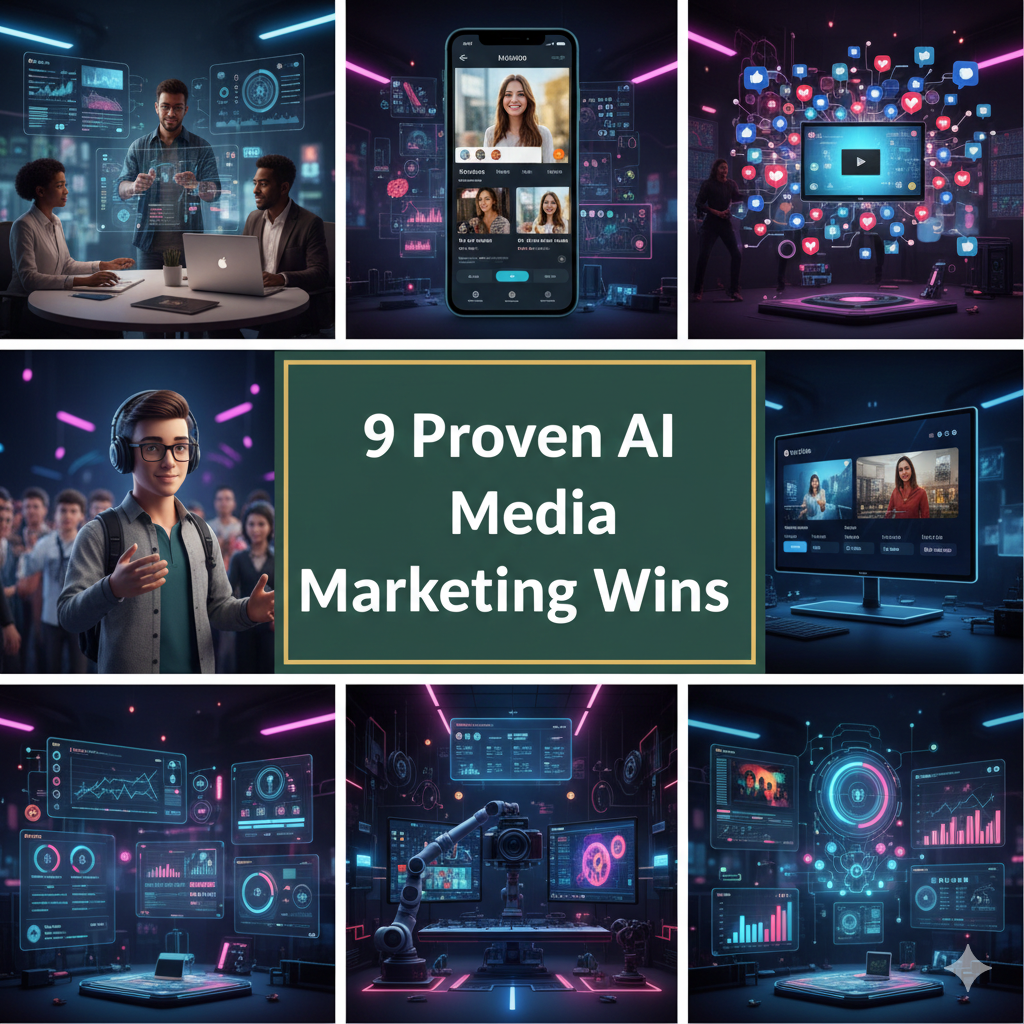
Here are 9 real AI media marketing wins with actual strategies, use cases, and results. Whether you work at a small business, handle a brand’s social media, or are in digital advertising, something here is for you.
Let’s get into it.
AI Media Marketing: It’s Not All Hype
Before we dive into the wins, it’s important to understand why this is significant.
AI media marketing leverages artificial intelligence tools to develop content, post ads, assess incoming information, and engage customers. It’s not about replacing humans. It’s about giving humans superpowers.
Businesses using AI in marketing see productivity rise up to 40 percent, according to a 2024 McKinsey report. That’s not small. That’s the difference between a struggling campaign and a winning one.
AI tools can:
- Read millions of data points instantly
- Anticipate what customers are looking for before they start searching
- Write customized content for thousands of people at scale
- Make and optimize advertisements without continuous human intervention
Now to the 9 wins that prove it.
Win #1 — Advertising That Actually Works, Thanks to AI
Stop Guessing, Start Knowing
Old-school ad targeting was like throwing darts in the dark. You would choose an age range, location, and perhaps a few interests, and hope for the best. AI changed that completely.
Now, platforms like Meta, Google, and TikTok employ machine learning to analyze user behavior, buying patterns, and even when users are most likely to buy or click during the day. The result? Ads that feel almost personal.
Real-World Example
Sephora employed AI-driven ad targeting to serve up different ads to different shoppers, based on their previous purchases and browsing history. They saw a 30%-plus increase in their return on ad spend (ROAS).
| Traditional Targeting | AI-Powered Targeting |
|---|---|
| Based on basic demographics | Based on behavior and intent |
| Manual updating required | Self-adjusts and learns over time |
| One-size-fits-all messaging | Personalized user by user |
| High ad waste | Lower cost per acquisition |
This is AI media marketing at its best — serving the right message to the right person at exactly the right moment.
Win #2 — Scale Content Creation Without Compromising Quality
More Content, Less Burnout
Creating content is exhausting. Blog posts, social captions, email newsletters, product descriptions — it just never ends. AI tools such as ChatGPT, Jasper, and Copy.ai have revolutionized the game, allowing companies to create quality content in minutes.
This isn’t cutting corners. It’s about working smarter.
How Brands Are Doing It
Big e-commerce players including Walmart and Amazon use AI to write product descriptions in bulk for thousands of items at once. What would take a team of writers weeks to complete gets done in hours — with robust quality standards and SEO-friendly language built in.
What You Can Scale With AI
- Blog articles and landing pages
- Email subject lines and body copy
- Social media captions and hashtags
- Ad copy variations for A/B testing
- Video scripts and podcast outlines
The trick is to use AI as a co-creator, not a substitute. Humans still bring the strategy, the brand voice, and the final editing eye.
Win #3 — Smarter Social Media Scheduling and Posting
Timing Matters in AI Media Marketing
If you post at the wrong time, your content gets buried. AI tools like Sprout Social, Buffer, and Hootsuite now use data to determine the best time to post for your specific audience — not general best practices, but yours.
These tools look at:
- When your followers are online
- What kinds of posts get the most engagement
- What topics are trending in your industry
- Historical performance statistics for your account
The Results Speak for Themselves
Brands that adopted AI-optimized posting schedules experienced an average 21% lift in engagement within 60 days, according to a Sprout Social study.
That’s more likes, more comments, and more shares — and more people seeing your brand without spending an additional dollar on ads.
Win #4 — Personalized Email Marketing That Doesn’t Feel Robotic
Why Generic Emails No Longer Cut It
People receive dozens of emails a day. Most go straight to trash. The emails that actually get opened? They feel personal. They speak directly to what the reader cares about.
That is something AI can make possible at scale.
How AI Personalizes Emails
Tools like Klaviyo, ActiveCampaign, and HubSpot use AI to:
- Segment audiences based on behavior — not just demographics
- Predict what a customer is most likely to buy next
- Write subject lines that align with reader preferences
- Send emails at the exact time each individual is most likely to open them
A Quick Case Study
One mid-size apparel brand implemented AI email personalization and its open rates skyrocketed from 18% to 34% within three months. Click-through rates doubled. Email revenue alone increased by 27%.
That’s the magic of making every subscriber feel that an email was composed just for them.
Win #5 — AI Chatbots That Convert Visitors Into Paying Customers
Your 24/7 Sales Team
A chatbot supported by AI does not need sleep. It responds to questions, suggests products, overcomes objections, and — in some cases — can even close the deal without a human on the other end.
It’s one of the most underrated wins in AI media marketing.
What Makes AI Chatbots Different
Old chatbots followed scripts. If you asked something unexpected, they crashed. The new breed of AI chatbots — the types powered by tools like GPT-4 and Google’s Gemini — actually understand context. They can hold real conversations, remember what you’ve told them earlier in a chat, and respond based on tone.
| Old Chatbots | AI-Powered Chatbots |
|---|---|
| Script-based | Conversational AI |
| Break on unexpected questions | Handle complex queries |
| No memory within session | Context-aware responses |
| One-language support | Multilingual capability |
| Basic FAQ answers | Full sales and support flows |
Real Numbers
According to Drift’s marketing report, companies that deployed AI chatbots experienced a 67% increase in lead conversions. That’s not just engagement — that’s actual revenue walking through the door.
Win #6 — Video Content Gets Smarter With AI
Video Reigns and AI Sharpens It
Video is the most consumed content type online right now. But creating great video consistently is hard. AI is changing that.
Marketers can use tools like Runway, Pictory, and Descript to:
- Automatically convert blog posts into short video clips
- Add captions and subtitles in seconds
- Remove background noise from audio
- Create AI voiceovers in multiple languages
- Repurpose long videos into short Reels or TikTok content
What This Means for AI Media Marketing
AI-optimized video content gets more reach. YouTube’s algorithm, for example, favors videos with strong watch time and accurate metadata — both of which AI tools can help maximize.
According to a HubSpot content study, brands that repurposed their long-form content into short AI-edited clips saw an average 3x increase in social media reach within six months.
Win #7 — Predictive Analytics That Stop Budget Waste
Know What’s Going to Work Before You Spend a Dollar
Wasted budget is one of the biggest problems in marketing. You try a campaign, it bombs, and you’re out thousands of dollars. Predictive analytics — fueled by AI — helps you avoid that.
How Predictive Analytics Works
AI reviews historical campaign data, customer behavior insights, industry demand trends, and competitor activity to anticipate:
- Which campaigns are likely to perform well
- What types of visitors are most likely to convert
- When customer demand is expected to spike
- What type of content will resonate this month versus next month
Who’s Using It
Netflix uses predictive AI to determine which shows to push to which users — decreasing churn and increasing watch time. Nike uses it to know which products are going to trend in which regions, so they can more efficiently allocate marketing dollars.
For smaller brands, tools like Salesforce Einstein and Google Analytics 4’s predictive features bring that same power to everyday marketers.
Win #8 — AI-Driven Influencer Marketing Matching
Finding the Right Influencer Is Harder Than It Looks
Influencer marketing is huge. Yet choosing the wrong influencer wastes money quickly. Fake followers, weak engagement rates, mismatched audiences — these are all real problems.
AI fixes this.
How AI Connects Brands With Influencers
Platforms such as Upfluence, Heepsy, and Modash rely on AI to assess:
- Real engagement rates — not just follower counts
- Audience demographics and interests
- Content tone and brand alignment
- Past campaign performance data
- Fraud detection for fake followers and bots
The Result
Brands using AI-powered influencer matching report up to 50% better ROI compared to manually selecting influencers. That’s because the match is based on data — not gut feeling or surface-level popularity.
This win is a game changer for not only big-name brands but also small businesses that have been trying to make influencer marketing work without a hefty budget.
Win #9 — Real-Time Sentiment Analysis for Stronger Brand Decisions
Know What People Are Actually Saying About You
What is the internet saying about your brand right now? If you don’t know, that’s a problem. AI-powered sentiment analysis tools scour social media, reviews, forums, and news articles to provide you with a live snapshot of public opinion.
Tools That Do This Well
- Brandwatch — Monitors millions of online conversations and organizes them by sentiment
- Mention — Keeps a check on brand mentions and analyzes tone
- Talkwalker — Social listening paired with AI-driven trend spotting
Why This Matters
So maybe your new product has just hit the market. Within hours, AI sentiment analysis tells you that 70% of the discussion is positive, but there’s a persistent complaint about packaging. You can respond quickly — before a tiny inconvenience turns into a PR disaster.
Companies that use real-time sentiment analysis make better decisions. They pivot campaigns faster, handle customer complaints more rapidly, and protect their brand reputation more efficiently.
For more insights on how media and digital strategy connect in today’s landscape, Media Progresif is a great resource to explore.
How These 9 Wins Work Together
Here’s the big picture. These are not just 9 different strategies. They work as a connected system.
AI Ad Targeting → Right person sees your brand
↓
AI Content Creation → They engage with your content
↓
AI Social Scheduling → Content reaches them at the right time
↓
AI Email Personalization → They get follow-ups they actually care about
↓
AI Chatbot → They get answers and convert
↓
AI Video Optimization → They keep coming back for more
↓
Predictive Analytics → You keep improving the whole system
↓
AI Influencer Matching → You expand reach to new audiences
↓
Sentiment Analysis → You protect and grow your reputation
Stack up these wins and you get a full-funnel AI media marketing machine that works smarter at every step.
What to Watch Out For
AI is amazing, but it’s not infallible. Here are a few things to keep in mind:
Don’t lose the human touch. AI can write content, but it cannot replicate genuine connection. Always check AI-generated content and make sure it sounds like your brand.
Data privacy matters. AI tools rely on data. Make sure that any tools you use comply with privacy laws like GDPR and CCPA.
AI needs good input. Garbage in, garbage out. AI is only as smart as the data and prompts you feed it. Spend the time to learn how to properly use these tools.
FAQs About AI Media Marketing
What is AI media marketing? It is the application of artificial intelligence tools to strategize, create, distribute, and optimize marketing content and campaigns across digital platforms.
Is AI media marketing only good for big brands? No. There are many AI marketing tools available at price points that cater to small businesses. Canva’s AI features, Mailchimp’s smart automation, and Buffer’s AI assistant are all accessible to smaller teams.
Will AI replace human marketers? No. AI takes on routine tasks and data analysis, but human creativity, strategy, and emotional intelligence are still key. The sweet spot is when humans and AI work together.
How do I begin with AI in marketing? Start small. Choose a single focus — like email personalization or social scheduling — and experiment with an AI-powered tool for 30 days. Measure the results, and then expand from there.
Is AI-generated content good for SEO? Yes, if done right. AI content has to be reviewed, edited, and aligned with search intent. Google rewards useful, high-quality content — however it’s created.
How much does AI media marketing cost? It varies. Some tools — such as Google Analytics 4 and Meta’s AI ad features — are free. Others, such as Brandwatch or Salesforce Einstein, come with enterprise pricing. Nearly every small business can get started for less than $100/month.
Can AI help with video marketing? Absolutely. Tools like Pictory, Runway, and Descript make video creation, editing, and repurposing faster and easier than ever — even for people with no video editing experience.
Wrapping It All Up
AI media marketing is no longer the future. It’s the present.
The 9 wins covered in this article — from smarter ad targeting to real-time sentiment analysis — are happening today, within companies of all sizes, across nearly every industry.
The brands winning today aren’t always the biggest or the richest. They’re the ones who embraced AI early, tested consistently, and combined it with good old-fashioned human creativity and strategy.
You don’t have to nail all 9 at the same time. Choose one win that corresponds to your toughest marketing challenge right now. Start there. Get results. Then build from there.
The tools exist. The proof is in. The only question remaining — are you ready to put AI media marketing to work for your brand?