
How businesses promote themselves will never be the same again.
Artificial intelligence is no longer the stuff of science fiction. It’s a tangible, nuts-and-bolts tool that small businesses, startups, and big brands are using right now to get a leg up. From content creation to predicting customer behavior, AI is everywhere.
But there is a catch — very few are doing AI marketing the correct way.
They use it too little and forgo enormous benefits. Or they throw it into the void, and what comes back is bland content that nobody reads.
In this post, I’m going to share with you 11 smart AI marketing tips that are actually working in 2025. They’re actionable, easy to implement, and will help you grow — whether you’re a solo entrepreneur or in charge of running an entire marketing team.
Let’s get into it.
Why AI Marketing Is a Game-Changer Right Now

Here’s what you need to know at the beginning.
AI marketing is the practice of leveraging artificial intelligence software to plan, design, execute, and optimize your marketing strategy. This includes things such as chatbots, content generation, email automation, ad targeting, and customer analytics.
The numbers speak for themselves:
| Stat | Data |
|---|---|
| Marketers using AI | 88% are seeing a lift in efficiency |
| Time saved weekly with AI tools | Up to 12 hours per marketer |
| Conversion rate improvement | Up to 30%, thanks to AI personalization |
| Cost reduction in ad spend | 20–40% savings from AI targeting |
Source: HubSpot, Salesforce, McKinsey Reports (2024–2025)
These are not small gains. These are business-changing results.
Now here are the tips.
Tip 1: Leverage AI to Create a Smarter Content Strategy
Stop Guessing What to Write
Most marketers spend hours deciding what type of content to produce. AI fixes that.
Services such as ChatGPT, Jasper, and Semrush’s AI features can analyze what your audience is searching for, what keywords competitors are ranking for, and which topics have the greatest traffic potential.
You simply explain your niche and objectives to the tool. It provides you with a complete content roadmap.
How to Do This
Begin by feeding your main topic into an AI tool. Have it produce a list of 20 blog post ideas based on things people in your industry are searching for. Then use a tool like Google Trends or Semrush to verify which ideas have actual search volume.
Create a monthly content calendar based on that list. Stick to it.
Every single time in SEO, consistency trumps creativity.
Tip 2: Have AI Write Your First Drafts (Then Edit Like a Human)
The Fastest Way to Create More Content
This is one of the best AI marketing tips that saves marketers the most time.
AI tools can produce a 1,000-word blog post in less than two minutes. That is not an exaggeration.
But here’s the important thing — never publish AI content as is.
Google can detect AI-generated content. Even more importantly, your readers can tell when something sounds robotic and cookie-cutter.
The Right Workflow
Use AI to write the skeleton. Then go in and:
Add personal stories or examples. Include your brand voice. Fix any facts that seem off. Insert concrete information from reliable sources.
Consider AI your writing assistant, not your ghostwriter.
With this workflow, you could be cutting your content creation time by 60% without sacrificing any quality.
Tip 3: Auto-Personalize Each Email Using AI Tools
Generic Emails Are Dead
If you are still emailing your whole list the same email, you’re leaving money on the table.
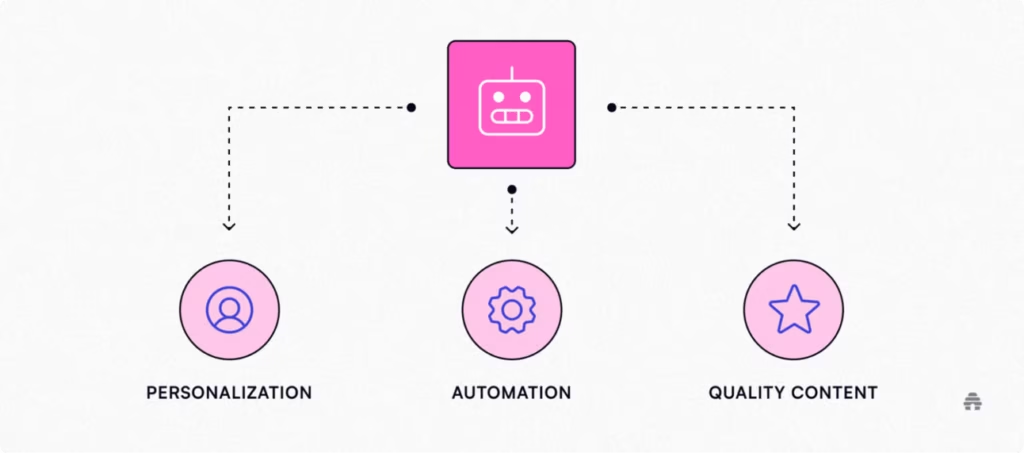
Email tools powered by AI such as Klaviyo, Mailchimp AI, and ActiveCampaign can segment your audience automatically. They consider behavior — what pages people visited, which products they clicked on, how much time they spent on your site — and cluster people based on that data.
Then they send the right message to the right person at the right time.
What Personalization Looks Like
Here is a simple example:
Someone browsed your running shoes and didn’t buy. AI sends an email 24 hours later with a subject like “Still thinking about those shoes?” and a 10% discount code.
That kind of personalization used to be available only through an enormous marketing team. Now it can be done automatically by just one person with the right AI tool.
AI Email Personalization vs. Traditional Email:
| Feature | Traditional Email | AI-Powered Email |
|---|---|---|
| Segmentation | Manual | Automatic |
| Send timing | Fixed schedule | Behavior-triggered |
| Subject line testing | A/B only | Multivariate AI testing |
| Average open rate | 18–22% | 30–45% |
| Time to set up | Hours | Minutes |
AI is transforming how businesses plan and execute their marketing strategies in 2025.
Tip 4: Get More Out of Your Paid Ads with AI Bidding
Stop Losing Money on Ads That Don’t Convert
Among the most underused AI marketing tips in the paid advertising space is letting AI control your bidding strategy.
Both Google Ads and Meta Ads now have built-in AI systems. They use machine learning to determine who’s most likely to click on your ad and actually become a customer — then automatically bid more to reach those people.
This is known as Smart Bidding on Google and Advantage+ on Meta.
Why This Matters
Without AI, bidding is essentially guessing. You set a bid and cross your fingers.
AI bidding analyzes hundreds of signals in real time — device, location, time of day, search history, and user behavior — to adjust your bid for every single auction automatically.
The result? Lower cost per conversion. Higher return on ad spend.
If you’re running ads and aren’t using these AI features, you’re overpaying.
Tip 5: Convert More Website Visitors with AI Chatbots
Your Website Needs to Talk Back
Most websites are silent. A visitor arrives, looks around, becomes confused, and leaves.
An AI chatbot shifts that dynamic entirely.
Chatbots such as Tidio, Intercom, and Drift can greet visitors immediately, answer commonly asked questions, collect emails, suggest related products, and even book calls — all without a human on the other end.
Where Chatbots Work Best
Homepage: Welcome visitors and guide them to the right place. Product pages: Answer questions before they bounce. Pricing page: Handle objections in real time. Blog posts: Offer related resources or free downloads.
A well-set-up chatbot can increase your conversion rate by 15–40% depending on your industry.
That is not a small number. That is real revenue.
Tip 6: Anticipate What Your Customers Will Do Next
The Power of Predictive Analytics
This sounds complex, but it is actually simple in practice.
AI tools can analyze your previous customer data and predict future behavior. Things such as: who is most likely to buy again, who is about to churn, and what product a customer will want next.
Tools such as Salesforce Einstein, HubSpot AI, and Pecan.ai specialize in this.
How to Use This Right Now
If you own an ecommerce store, AI can predict which customers haven’t made a purchase in 60 days and are most likely to churn. You can create an automated win-back campaign targeting exactly those people.
If you offer a subscription service, AI can flag users who have decreased in activity — one of the strongest predictors that they will soon cancel. You make contact first, before they ever walk out the door.
Predictive marketing takes reactive businesses and makes them proactive.
Tip 7: Create Video Scripts and Social Posts Faster
AI Is a Social Media Manager’s Best Friend
Staying current on social media is exhausting. You need fresh content every day across multiple platforms.
AI tools like Lately.ai, Copy.ai, and even ChatGPT can take one blog post and generate:
10 tweets. 5 LinkedIn posts. 3 Instagram captions. 2 short video scripts.
All in minutes.
The Repurposing Framework
Here is a simple system:
Produce one piece of long-form content per week — a blog post, a podcast transcript, or a video. Feed it into an AI tool and ask it to repurpose the content for other platforms. Review it, make a light edit, and schedule it using a tool such as Buffer or Hootsuite.
One piece of content turns into 15–20 pieces. That is an entire month of posts from a single source.
This is one of those AI marketing tips that feels almost unfair once you start using it.
Tip 8: Boost Your SEO with AI-Powered Keyword Research
Keyword Research Just Got a Whole Lot Faster
In the old days, keyword research involved hours — sometimes days — spent in spreadsheets. Now AI does it in seconds.
Tools like Surfer SEO, Clearscope, and Semrush’s AI assistant can:
Discover keywords your competitors rank for that you’ve overlooked. Find low-competition long-tail keywords. Suggest semantic keywords that help Google understand your content better.
Semantic SEO — Why It Matters
Google does not rank pages purely based on keywords. It ranks based on topic authority and relevance.
This means you need to cover a subject thoroughly — not just cram in one keyword 10 times.
AI-powered tools analyze top-ranking pages and tell you exactly what subtopics, questions, and related terms need to be included to outrank the competition.
This is called semantic optimization. And it’s one of the largest SEO shifts in recent years.
For more in-depth digital marketing guidance and strategies, visit Media Progresif — a solid resource for marketers looking to stay ahead in the digital space.
Tip 9: Leverage AI to Know More About Your Competitors
Know What Your Competitors Are Doing
You cannot outmaneuver your competitors if you don’t know what they are doing.
AI-powered tools like SpyFu, SimilarWeb, and Crayon track competitor websites, ads, content, and pricing in real time. They alert you when a competitor launches a new campaign or adjusts their messaging.
What to Look For
Best-performing competitor content — so you can beat them at their own game. Keywords they are targeting in paid search. Changes to their homepage or offer. New products or promotions they are pushing.
This kind of competitive intelligence used to require a whole team. Now a single AI tool does it all automatically.
Stay aware. Stay ahead.
Tip 10: Score and Qualify Leads with AI
Not Every Lead Is Worth Your Time
If your sales team is treating every lead the same, they are wasting time on people who will never buy.
AI lead scoring tools such as HubSpot, Marketo, and Zoho CRM use machine learning to automatically score every lead according to how likely they are to convert. They consider things like job title, company size, website behavior, email engagement, and more.
High-scoring leads are prioritized. Low-scoring leads are automatically nurtured.
The Result
Your sales team spends time only on the hottest leads. The rest is taken care of automatically by your marketing team. Nobody falls through the cracks.
This alone can increase your close rate by as much as 30–50%.
Tip 11: Test Everything Faster with AI-Powered A/B Testing
Guesswork Is Expensive
Every email you send and every ad you launch involves decisions. AI makes those decisions smarter.
Traditional A/B testing lets you test one variable at a time — say, two different subject lines. Then you wait weeks to collect enough data to know which one won.
AI-driven multivariate testing tools such as Optimizely and VWO can test dozens of combinations at once. They identify the winner faster and automatically shift traffic to the best-performing version.
What You Can Test with AI
Subject lines and send times for emails. Ad headlines and images. Landing page layouts and CTAs. Product page descriptions and pricing displays.
The more you test, the better everything performs. And AI is making testing faster, smarter, and cheaper than ever before.
Wrap Up — Your AI Marketing Action Plan
Here is a quick look at all 11 tips:
| Priority | AI Marketing Tip | Best Tool to Start With |
|---|---|---|
| 🔥 High | Content strategy | ChatGPT + Semrush |
| 🔥 High | Email personalization | Klaviyo or ActiveCampaign |
| 🔥 High | AI chatbots | Tidio or Intercom |
| 🔥 High | SEO keyword research | Surfer SEO or Clearscope |
| ⚡ Medium | AI-powered ads | Google Smart Bidding / Meta Advantage+ |
| ⚡ Medium | Competitor analysis | SpyFu or SimilarWeb |
| ⚡ Medium | Lead scoring | HubSpot or Marketo |
| ⚡ Medium | First draft writing | Jasper or ChatGPT |
| 💡 Long-term | Predictive analytics | Salesforce Einstein |
| 💡 Long-term | Content repurposing | Lately.ai or Copy.ai |
| 💡 Long-term | A/B testing | Optimizely or VWO |
Start with the high-priority ones. Get comfortable. Then add more layers over time.
You don’t have to do it all at once. Choose 2–3 tips from this list and put them into play this week.
FAQs About AI Marketing Tips
Q1: Do I have to have a lot of money to invest in AI marketing tools?
Not at all. Many AI marketing tools offer free plans or low-cost starter options. ChatGPT, Google’s Smart Bidding, and basic versions of Mailchimp and Tidio can all be used without a large budget. You can start small and grow as you see results.
Q2: Is AI going to take all the marketers’ jobs?
No. AI is a tool, not a substitute. The best outcomes happen when humans and AI cooperate. Repetitive tasks and data analysis are left to AI. Strategy, creativity, and relationship-building are handled by humans. That combination is unbeatable.
Q3: Is AI-generated content good for SEO?
It can be — but only if you edit it properly. Google favors useful, unique, high-quality content. Published without a touch of human editing, raw AI copy will tend to underperform. Leverage AI to accelerate the process, then add the human touch to make it truly valuable.
Q4: How soon can we see results from AI marketing?
It depends on the strategy. AI email personalization and chatbots can show results within days. SEO improvements from AI keyword research typically take 3–6 months to show significant gains. Paid ad improvements with Smart Bidding usually become visible within 2–4 weeks.
Q5: What is the single best AI marketing tip to start with?
If you’re just getting started, begin with AI for content strategy and first drafts. It saves the most time immediately and helps you build a solid foundation for everything else. Once you have a content engine running, layer in email personalization and chatbots.
Q6: Are AI marketing tools safe to use for my business data?
Reliable AI marketing platforms generally have strong privacy policies and comply with regulations such as GDPR. Always review the terms of service before connecting your customer data to any tool. Do not share sensitive information with applications that do not have clearly defined data policies.
Final Thoughts
AI marketing is not a trend. It is the new standard.
The businesses winning right now are not the ones with the largest budgets. They are the ones using their resources smarter. They’re the ones letting AI do the grunt work, so their team can concentrate on strategy, creativity, and authentic human connection.
These AI marketing tips cover everything from content and SEO to ads, email, and lead generation. Each one is built to save you time, cut waste, and turbocharge your growth.
The best time to begin implementing AI in your marketing was last year. The next best time is today.
Pick one tip. Try it this week. Then come back and try another.
Small actions done consistently lead to huge results.